


The meeting ends, but the work of sorting it out is just beginning. Someone needs to find the commitments, compare them with earlier emails, assign tasks and check which customer records need attention.
The information exists. It's scattered across the places where the conversation happened.
For me, AI marketing for small business starts with that kind of recurring manual digital work: entering data, assembling a report or moving information from one system to another. The right first task depends on your business and what keeps landing back on someone's desk.
This guide explains how I approach those choices across marketing and sales. It combines my experience with a fictional meeting example, so you can see the proposed outputs, the unanswered questions and the decisions a person still needs to make.
Start by finding recurring manual digital work in your business: entering data, building a report or moving information between systems. Define the input, desired output and human check. One meeting transcript might support both action items and a deal-attention review, using the connectors available in your AI environment.

What does AI marketing mean for a service business?
AI marketing means using AI to help with specific marketing and sales tasks, while keeping someone responsible for the result. That might involve preparing an explanation of a service, organizing research or identifying follow-up work in meeting notes. The useful starting point is a job you already understand well enough to review.
In the U.S. Chamber of Commerce's 2026 Empowering Small Business report, 41% of respondents whose businesses used AI reported using it for marketing or promotions. The survey covered U.S. firms with fewer than 250 employees, across industries. It describes how respondents use AI; it doesn't measure how well your first project will work.
The work can be quite modest. Give an assistant approved service facts and ask for a clear explanation for prospective customers. You can then check whether it describes the service accurately, answers a real question and makes promises the business can keep.
Other jobs need a different approach. Copying an inquiry's email address into a customer relationship management system, or CRM, may need a fixed rule. Deciding what an ambiguous meeting comment means requires interpretation. Connecting several steps also introduces more places to check.
I use AI enablement for a business to describe the work of finding those practical uses and making them usable. A sensible first result might be a reviewed draft or a short list of proposed tasks. It doesn't have to be a large system.
Which marketing and sales jobs are useful places to look?
Look for work that repeatedly asks someone to gather, interpret or transfer information. Then name the input, the proposed output and the person who can judge it. The table below is a starting map for owner-led service businesses. Its checks matter as much as the output you hope to produce.
| Business job | Give AI this input | Ask for this output | Who checks it, and what counts as usable? |
|---|---|---|---|
| Organize business knowledge | Current service facts, dated notes and unresolved questions | A focused summary with sources | The owner resolves conflicting facts and approves what the business can claim. |
| Prepare useful content | A reader's question, approved facts and source material | An outline or draft | An editor verifies claims and checks that the answer helps the intended reader. |
| Inspect search and website issues | Actual pages, URLs and observed behavior | Findings or possible internal links | A website reviewer opens destinations and separates observed problems from possible causes. |
| Check inquiry capture | Test submissions and expected fields | A mapping or check plan | An implementer compares submitted values with saved CRM values. AI may be optional here. |
| Prepare follow-up work | Meeting notes and relevant correspondence | Proposed actions and possible duplicates | A task owner checks the source, responsibility and any condition before approving the item. |
| Review deals needing attention | Meeting updates and the matching CRM records | A brief explaining gaps and proposed next steps | The person responsible for sales verifies the record, stage and reason for attention. |
| Develop creative | An owned image or original scene, plus constraints | A candidate visual or video treatment | A creative reviewer checks whether important details changed. |
These jobs connect, but they need different kinds of judgment. In my content work, I've separated research, drafting, claim verification, editing and publication checks. A readable draft is only one part of that process. Google's guidance likewise calls for accuracy, quality and relevance when using generative AI for website content (Google Search Central, 2026).
I've also built a local tool that proposes internal links and exports recommendations for review. A suggested link isn't an implemented link. Someone still has to check the destination, decide whether it belongs in the passage and verify the change when it's made.
For a contractor, the useful task might be gathering questions from estimate meetings. An appointment-based business might need help organizing repeated customer questions. A consulting practice might spend too much time preparing the same weekly report. These are possible starting points, not a required sequence.
Ask where information gets handled repeatedly before it becomes useful. That question often reveals a more specific project than “we should use AI for marketing.” It also gives the person doing the work a say in what needs improving.
What information should you give AI before asking it to help?
Give AI the facts and limits needed for the task in front of it: the service, the intended reader, the source material, the requested output and the unknowns. Keep your instructions separate from the material it should examine. A meeting transcript supplies evidence; it doesn't decide what the business should do next.
Approved facts
Start with information someone at the business can stand behind. For a service description, that could include the work offered, service area, exclusions and current offer terms. For a meeting review, it could be the transcript, the relevant email and the matching CRM record, with enough context to distinguish one deal from another.
I've organized business knowledge into reusable context libraries with source notes and evidence cards. That makes it easier to identify what supports a statement. It also leaves room to flag information that conflicts or needs updating. An old note shouldn't quietly overrule a current decision.
The requested output
Describe what the result should look like and where it will be used. “Summarize this meeting” leaves room for a polished recap that doesn't help anyone act. “Propose action items, with the supporting passage, owner and unresolved timing” gives the reviewer something more concrete to work with.
Unknowns and exclusions
Tell the assistant which gaps to preserve. If someone says they can prepare a proposal after receiving missing information, the output should keep that condition. It shouldn't invent a due date, declare the proposal sent or choose an owner for an unassigned request.
This emphasis on context and responsibilities is consistent with NIST's voluntary AI Risk Management Framework. Its mapping guidance considers intended uses, limits and human roles. The practical application here is straightforward: make the task clear enough that someone can tell when an output goes beyond the evidence (NIST, 2023).
What should a person check before using the output?
Check the output against the job it will perform, using the original source wherever possible. A content draft needs factual review. A proposed task needs a supported action and a clear owner. A CRM change needs the right record and value. “Looks reasonable” isn't a sufficient check for all of those jobs.
The SBA's small-business AI guidance recommends starting with small uses and having people review outputs, including messages before they go to customers. That review becomes more useful when you define what the reviewer is looking for (U.S. Small Business Administration, accessed October 4, 2026).
For this guide, I suggest three review outcomes:
- Supported: The source backs the proposed statement or action, and the relevant check passes.
- Needs revision: There is a useful result, but wording, conditions or other details need correction.
- Cannot verify: The source is missing, conflicting or insufficient. Keep the question open.
Consider a deliberately flawed summary from our fictional example: “North Quay proposal sent.” The actual commitment is to prepare the proposal after the customer sends a room list. The room list hasn't arrived. This is a constructed example of wording to reject, not a reported failure from a real customer workflow.
Changing it to “Prepare the proposal after the room list arrives” preserves the commitment. It still leaves another job unresolved: who will request that list? A good review makes that gap visible instead of filling it with a guess.
The same principle applies beyond text. I've traced form fields through CRM mappings and checked saved values. I've also reviewed generated video against the source image for changes to scene details. In both cases, the output needs checking where the error would matter, not only in the assistant's explanation.
If the underlying problem is moving reliable information between tools, the next step may be to connect your marketing systems. Keep the receiving system in the check: a proposed field mapping and a correctly saved field are different stages of the work.
How can one meeting support action items and deal attention?
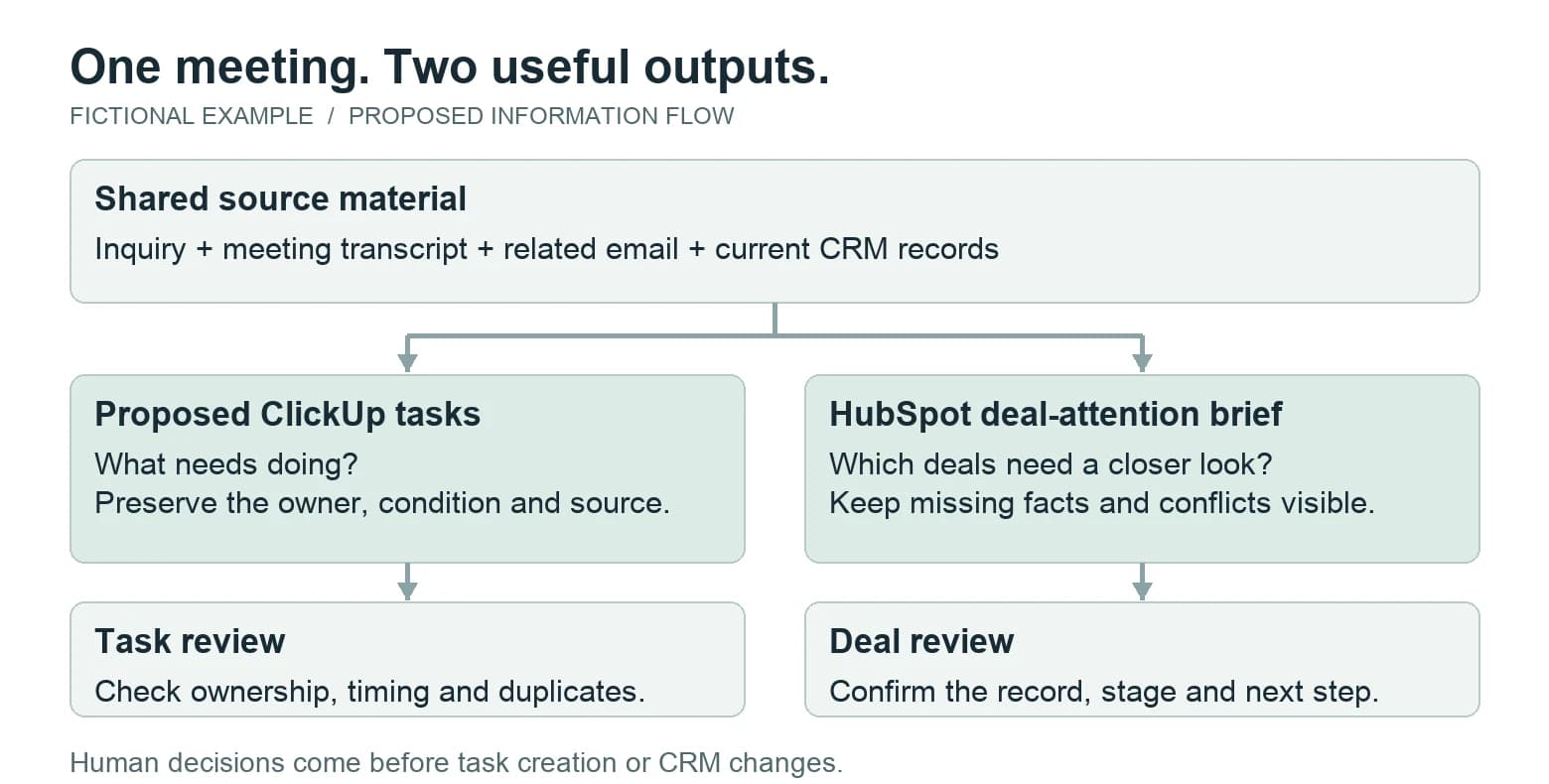
One meeting transcript can support two separate outputs: proposed tasks and a review of deals needing attention. The task output asks what needs doing. The deal review asks what the current information means for the next sales decision. The fictional example below shares its source material while keeping those decisions separate.
I've used HubSpot, Outlook and Plaud connectors to monitor action items from meetings, with the goal of turning captured notes into ClickUp tasks. I've also used Plaud and HubSpot with the same meeting transcription to review deals and where customers are in the process. The aim is to keep commitments visible and give important deals appropriate attention.
I sometimes call the assistant environment an “AI harness”: the place where the assistant can use the tools and connectors available to it. Those connections depend on the environment, permissions and operations each connector supports. Check the actual handoff before relying on it, including whether the assistant can read information, make changes or both.
Plaud's MCP documentation illustrates one part of that connection: a supported assistant can retrieve notes and transcripts with timestamps. Access to a transcript gives it material to work from. Sending a message or saving a task requires its own supported connection and check.
A fictional meeting with unfinished business
Cedarline Workspace Services is a fictional company handling office reset projects and recurring workspace upkeep. North Quay Studio has asked about resetting two workrooms, but its storage needs are unknown. Cedarline's CRM lists that opportunity as Discovery, awaiting a room list. A second opportunity, Marlow Workshop's recurring upkeep, is listed as Proposal sent, with decision timing unconfirmed.
In the meeting, Priya says she can prepare North Quay's proposal once the room list arrives. Her email repeats the same conditional commitment. That's one job described in two places.
Morgan points out the snag: nobody has been assigned to request the list.
Marlow introduces a different uncertainty. Priya says it is still reviewing the proposal and has given no decision date. Morgan thought it had approved the proposal, but asks for a check before anyone changes the deal. Neither statement settles the conflict.
Proposed actions
| Proposed item | Owner and timing | What the reviewer must preserve |
|---|---|---|
| Prepare North Quay's proposal | Priya; only after the room list arrives; no due date stated | Priya's meeting statement and email describe the same commitment. Flag the overlap. |
| Request North Quay's room list | Unassigned; no due date stated | Morgan identifies the missing owner in the meeting. Assign responsibility before creating an assigned task. |
| Verify Marlow's proposal status | Unassigned; no due date stated | Priya's review update conflicts with Morgan's recollection of approval. Confirm before changing the record. |
A separate deal-attention brief
North Quay needs attention because a missing input blocks proposal preparation and nobody owns the request for it. Marlow needs attention because the meeting contains conflicting accounts of its status. Keep the existing stages visible while those questions are resolved. Neither record should advance on the strength of this meeting alone.
The owner can now see why each deal needs attention and choose the next conversation. North Quay needs someone to obtain the missing information. Marlow needs confirmation of what the customer has decided. Assigning a priority without those reasons would hide the work still to do.
When should you fix the process before adding AI?
Fix the process first when the work lacks reliable facts, a clear handoff or someone responsible for the next step. AI can help expose those gaps, but its suggestion doesn't resolve them. Before connecting more tools, decide which business question or broken handoff is preventing someone from doing the job.
An unclear service promise needs an owner decision about what is actually offered. Missing inquiry details need a check of the form and where its fields are saved. Follow-up that belongs to nobody needs an assigned person. Those are different problems, even when they appear together in a meeting summary.
Adding more steps can make a weak process harder to understand. Anthropic's engineering guide Building effective agents, published in 2024, recommends beginning with a simple solution and adding complexity when it is warranted. Each additional connection should have a purpose you can explain and a result you can check.
My suggested sequence is to clarify the work, try a bounded task and examine the result before expanding it. If you're still deciding which business problem deserves attention, clarify your marketing priorities first. The useful outcome may be a better handoff, a fixed rule or a reviewed AI draft. Choose based on what the work needs.
How can you define one useful first AI project?
Define the project with a short task card: the recurring job, its inputs, the proposed output, a reviewer and an acceptance check. Add the unresolved information and a condition for stopping or revising the work. This gives you something concrete to try without committing to a larger system before you've examined a result.
Use the card below to make the choice specific. The completed example applies the meeting idea to fictional Cedarline. Your card might instead describe report assembly, draft service explanations or repeated data entry. Pick work that the person reviewing it understands well.
| Task-card field | Fictional example |
|---|---|
| Recurring manual job | Read meeting notes, compare email commitments and prepare follow-up work. |
| Inputs | The meeting transcript, overlapping email and matching CRM records. |
| Proposed output | Action items and a separate deal-attention brief, each tied to its source. |
| Reviewer | A designated person responsible for the meeting follow-up and sales review. |
| Acceptance check | Each item matches the source, preserves conditions and identifies uncertain ownership or status. |
| Unresolved information | Who requests the room list? Has Marlow approved the proposal? |
| Stop or revise condition | Reject invented completion, owner, due date or deal-stage claims. |
| Next action | Review the proposed items, assign unresolved work and verify conflicting information. |
Keep the first output in draft form. Compare it with the way you'd normally complete the same task, including the time and effort needed to check and correct it. If you measure that comparison, include preparation and rework, not just how quickly the assistant produces text.
You may find that the output is useful but the input takes too much effort to assemble. That points to an information-gathering problem worth examining next. If a missing owner causes most of the difficulty, assign responsibility and try again. Use the card to decide what to change before investing in a larger setup.
Common questions about AI marketing for small business
Do I need a new AI tool to get started?
You may already have enough to try a small, reviewable task. Define the job and identify the necessary inputs before comparing products. An assistant that accepts a document may be sufficient for a first draft. Connected work needs a separate check of access, permissions and supported operations.
Can AI write my marketing content?
AI can assist with research, outlines and drafts. Your business still needs useful source material and someone who can check the claims. Google's guidance allows for generative AI's usefulness while emphasizing accuracy, quality and relevance. Editing should test those things, not just whether the wording sounds polished (Google Search Central, 2026).
Can AI handle lead follow-up automatically?
Preparing a proposed follow-up and sending it are separate capabilities. Automatic sending depends on the tools, connection and permissions involved, along with rules for exceptions. This guide shows preparation and review. It doesn't establish an unattended sending system or prove that a particular connector can perform every step.
Will using AI help my business appear in AI search?
Using AI to write doesn't establish visibility in AI search. For its own Search features, Google emphasizes useful, original content and established SEO practices; it doesn't promise inclusion or require a special writing format. Make the page helpful and accessible, then check where it actually appears (Google Search Central, 2026).
How will I know whether the first project is useful?
Decide what a usable result looks like before the trial, then review the output against that standard. Include missing details, corrections and review effort in your assessment. A plausible draft that requires extensive repair may not improve the work. Compare what you can actually use, rather than counting generated material.
Start with one task worth improving
Choose a recurring task you can describe, supply with reliable information and put in front of a responsible reviewer. That could be preparing a report, organizing meeting actions or checking which deals need attention. Keep the first attempt small enough to inspect, and let what you learn determine the next step.
If you'd like help making that choice, bring one marketing or sales task you'd like to improve. We'll use a free 60-minute strategy session to look at where AI fits and what needs to be in place first. Start with the work that's already on your desk.
Related serviceAI Enablement: Build AI into how your team researches, creates, analyzes, sells, and operates.